
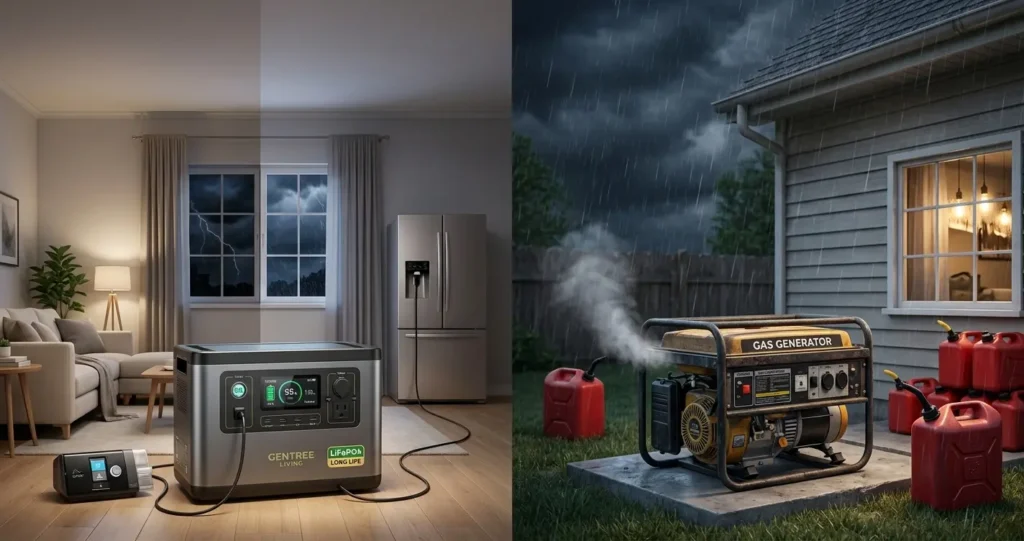
Hurricane season, an ice storm, or just an aging grid that flickers every time the wind picks up — the reasons homeowners start looking at backup power rarely have anything to do with camping. It’s about keeping the refrigerator running and a medical device charged during a multi-day outage. For most of that history, the default answer has been a gas generator. It doesn’t have to be the only one anymore.
What a Gas Generator Actually Requires
A gas generator’s real advantage is simple: as long as fuel keeps arriving, it can run indefinitely. That’s genuinely valuable for an outage that stretches many days. But it comes with real ongoing requirements — fuel stored on-site (itself a safety consideration), regular maintenance most homeowners forget about until the moment they need it, and operating noise and exhaust that mean it has to run outdoors, away from windows and doors.
What a Battery Power Station Actually Offers
A battery-based power station solves the same problem differently: no fumes, no fuel runs, quiet enough to run indoors or right outside a window, and increasingly enough capacity to matter during a real outage rather than just topping off phones. The honest trade-off is capacity — a battery unit has a fixed charge and will eventually run out, where a gas generator won’t as long as you can keep feeding it fuel.
For most homeowners, the deciding factor is how long outages actually run in your area. A battery unit is simpler, quieter, and safer to operate near living space for outages measured in hours to a day or two. For outages that stretch multiple days without power, the calculation changes — and that’s where solar recharging becomes the real differentiator, since a battery unit paired with solar panels can keep recharging through an extended outage in a way a gas generator obviously can’t once the gas station lines start forming.
The Detail Worth Knowing: Battery Chemistry
Not all battery power stations are built the same way underneath. LiFePO4 (LFP) battery chemistry, used in many of the more established home-backup units, is rated for roughly 3,000 charge cycles — which independent reviewers and manufacturers both generally put at around a decade of typical use before capacity meaningfully declines. That’s a real durability difference worth checking on any unit you’re considering, not just capacity and price.
What We Can’t Verify — And Say So
Exact runtime, recharge speed, and capacity vary significantly by specific model and by what you’re actually running on it — a refrigerator and a router draw very differently than a refrigerator, medical equipment, and box fans running simultaneously. We’re not going to give you a single number here that claims to cover every household’s situation. Check a specific unit’s rated continuous output and your own essential-appliance wattage before buying, since undersizing a battery unit for your actual needs is the most common mistake homeowners make with this purchase.
The GenTree Living Take
Neither option is universally right. A battery power station is the better fit for most Northeast homes dealing with shorter, more frequent outages — ice storms, wind events, brief grid failures — especially paired with solar for longer stretches. A gas generator still makes sense for households that regularly face multi-day outages with no solar option. The honest first step either way is looking at how long your area’s outages have actually run over the past few years, not how long they theoretically could.
This article is educational content, not a product review. GenTree Living evaluates specific backup-power products on a case-by-case basis before recommending them.