
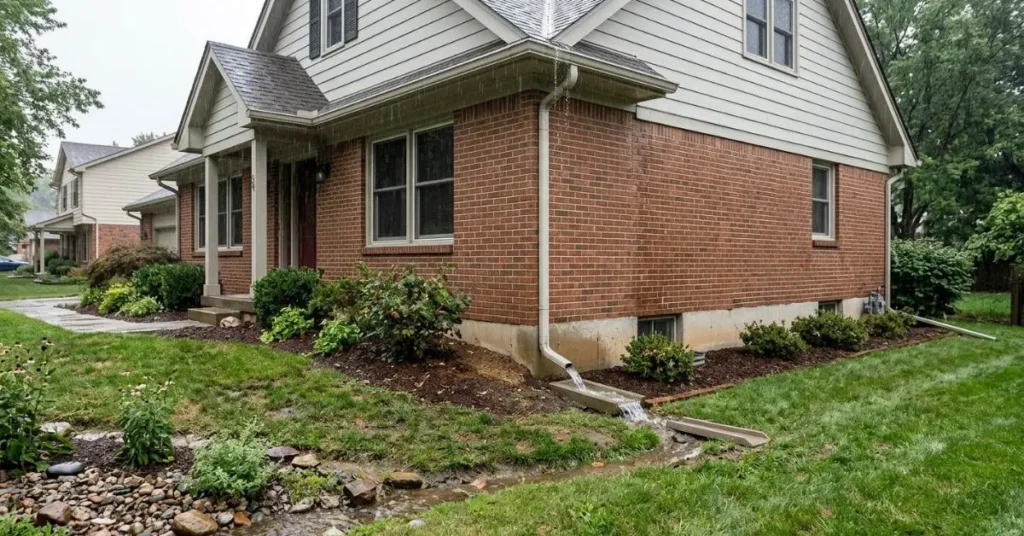
A damp mark on a basement wall naturally draws your attention to the basement. But the first place to investigate may be somewhere else entirely — at the roofline, beneath the downspouts, or in the ground immediately surrounding the foundation.
That is because a home manages water as one connected system. The roof collects it. The gutters direct it. The downspouts discharge it. The surrounding grade determines where it travels next.
When one part of that system stops working as intended, the basement may be where the evidence finally appears.
Why the First Six Feet Matter
Rainwater and melting snow naturally move toward the lowest available point. The ground surrounding a home should help direct that water away from the foundation rather than allowing it to collect beside it.
The first six feet around the house provide a useful observation area. Does the ground slope away from the foundation? Is it flat? Has it settled into a low area — or begun sloping toward the house?
Professional recommendations vary according to the property, soil, drainage system, and local requirements. The important principle is simple: water should continue moving away from the foundation instead of pooling beside it.
Surface drainage is not the only possible source of basement moisture. Groundwater, plumbing leaks, condensation, foundation conditions, and indoor humidity may also contribute. But roof runoff and grading are practical places to begin looking.
Follow the Water Backward
Start at the roofline.
Gutters and downspouts should do more than move water off the roof. They should direct it to a location where it can continue flowing safely away from the house.
A downspout that empties beside the foundation may concentrate hundreds of gallons of roof runoff into one small area during a heavy rain. An extension, properly positioned splash block, or appropriately designed underground drainage system may help carry that water farther away.
The correct solution depends on the home, the surrounding grade, neighboring properties, and local drainage requirements. Water should never be redirected in a way that creates a new problem elsewhere.
Next, look at the grade surrounding the foundation. Ideally, the ground should slope away from the house. If it is flat — or slopes inward — rainwater may remain close to the foundation longer than it should.
Why Conditions Change Over Time
Drainage conditions rarely change all at once.
Soil settles. Mulch beds are gradually built higher. Downspout extensions become disconnected. Splash blocks are moved by lawn equipment and never returned to their original position. Gutters loosen, clog, or begin overflowing in places that are difficult to see from the ground.
These small changes help explain why a homeowner can live in a house for years before noticing basement moisture. Nothing dramatic may have “broken.” The conditions surrounding the home may simply have shifted little by little.
Houses rarely fail all at once. They whisper first.
What to Notice During the Next Rain
From a safe position on the ground, watch what happens when it rains:
- Are the gutters overflowing or allowing water to spill behind them?
- Do the downspouts remain connected?
- Does each downspout release water where it can continue moving away?
- Are splash blocks or extensions properly positioned?
- Does water collect near the foundation?
- Does the surrounding ground slope away from the house?
- Have patios, walkways, or planting beds created low areas that hold water?
These observations will not diagnose the source of basement moisture, but they can help you have a more productive conversation with a drainage, gutter, landscaping, waterproofing, or other qualified professional.
If water is entering near electrical equipment, creating standing water, producing extensive mold growth, or appearing suddenly in significant amounts, seek appropriate professional assistance promptly.
Look Upstream Before Choosing a Solution
A damp basement does not automatically mean the foundation needs an expensive repair. Nor does correcting a downspout guarantee that every moisture condition will disappear.
It means the house deserves to be considered as a connected system.
Before deciding what to repair, follow the water backward. Begin where it lands, observe where it travels, and notice where that journey changes.
Sometimes the smallest observation leads to the smartest decision.
Connect the Observations Across Your Home
The GenTree Property Intelligence Report™ helps organize observations from eight areas of the property — including the roof, exterior, site drainage, and basement — into clear priorities for planning and appropriate professional follow-up.
It is designed to help answer the next important question:
What should I do next?
Available for $149.