The attic is one of the easiest parts of a home to overlook. It sits above the rooms we use every day, quietly affecting comfort, energy use, and sometimes moisture — yet many homeowners have not looked inside since moving day.
You do not need to become an insulation expert. You simply need to know what may be worth noticing.
Begin With the Insulation
Insulation slows the movement of heat between your living space and the attic. When insulation is missing, compressed, uneven, or no longer sufficient for the home and climate, rooms may become harder to keep comfortable.
There is no single insulation level that is right for every house. Recommended R-values depend on where the home is located, how much insulation is already present, the type of insulation, and the way the attic was constructed.
A rough visual check can still be useful. Look for areas where the insulation appears thin, disturbed, compressed, wet, or uneven. These observations do not diagnose the cause, but they can help you decide whether a qualified insulation or energy professional should take a closer look.
What Darkened Insulation May Be Saying
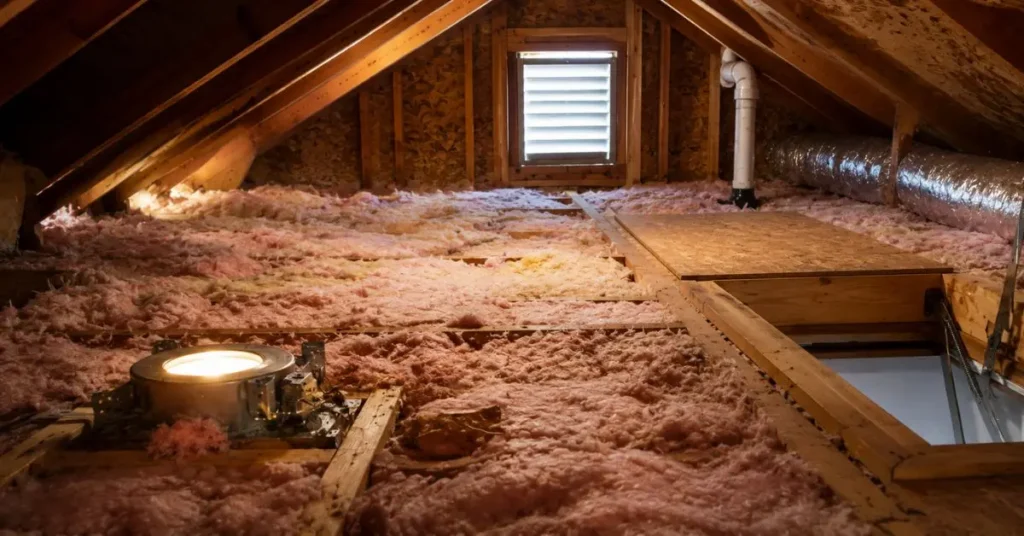
Dark staining on fiberglass insulation may provide a clue that air has been moving through or around it.
Fiberglass can act somewhat like a filter, collecting dust carried by moving air. Darkened areas near wiring, plumbing penetrations, wall openings, or other gaps may therefore point toward possible air-leakage pathways.
But discoloration does not prove that air leakage is the only cause. Wet insulation, roof leaks, condensation, soot, or other conditions may create a similar appearance. Treat the staining as something to notice and investigate — not as a diagnosis.
Recessed Lighting: Two Ratings That Matter
Recessed “can” lights installed beneath an unconditioned attic can create openings through the ceiling’s air barrier.
Two different ratings are important:
- IC-rated means the fixture is designed to be in contact with insulation.
- AT-rated means the fixture is designed to limit air leakage.
A fixture may be IC-rated without being airtight. Fixtures labeled ICAT address both insulation contact and air leakage.
Insulation should not be placed against a non-IC-rated fixture. If you cannot identify the fixture’s rating, do not cover, seal, or alter it yourself. Ask a qualified electrician or insulation professional to determine the appropriate next step.
Do Not Forget the Attic Hatch
A pull-down attic staircase or access hatch interrupts the insulation and air barrier separating the living space from the attic.
If the hatch is uninsulated or poorly sealed, air can move through the opening even when the rest of the attic has adequate insulation. A properly fitted insulated cover and weatherstripping may help reduce that leakage.
The right solution depends on the type of access, available clearance, and the way the ladder or hatch operates. The goal is not merely to add insulation — it is to create a safe, continuous boundary between the home and the attic.
Take a Safe Look — If Access Allows
If the attic is safely accessible, look from a stable platform or floored walkway. Notice:
- Whether the insulation appears even or disturbed
- Whether any areas are darkened, damp, or compressed
- Whether the attic hatch appears insulated and weatherstripped
- Whether recessed-light housings have visible IC, AT, or ICAT labels
- Whether bathroom, kitchen, or dryer vents appear to terminate inside the attic
Do not step on ceiling drywall, touch exposed wiring, disturb insulation, or move through an attic without secure footing.
If you see loose, pebble-like vermiculite insulation, leave it undisturbed. Some vermiculite insulation may contain asbestos and should be evaluated by an appropriately qualified professional.
Awareness Is the First Step
You do not need to solve everything during one trip to the attic. The purpose of looking is to understand what your home may be communicating.
A thin area of insulation, a darkened batt, an unsealed hatch, or an unidentified light fixture may simply become an item to document and discuss with the right professional.
That is how home preservation begins: not with panic, but with one informed observation followed by a better decision.
Ready to Organize What You Are Noticing?
The GenTree Property Intelligence Report™ helps organize observations from eight areas of the home into clear priorities for planning and appropriate professional follow-up.
It answers the next important question:
What should I do next?
Available for $149.