Affiliate Disclosure: GenTree Living may earn a commission if you buy through links on this page, at no extra cost to you. As an Amazon Associate, GenTree Living earns from qualifying purchases.
Researched and written for GenTree Living. Edited by John McBride, Connecticut REALTOR® since 1987 and Senior Home Safety Specialist (SHSS®). This is a buying guide based on manufacturer specifications and public safety guidance, not a hands-on product test, and it is not medical advice.
Many of the most worrying moments at home happen at night. Someone wakes up, gets out of bed a little groggy, and makes their way to the bathroom in the dark. The bed, the hallway, and the bathroom doorway are a short route, but a tricky one when you are tired and cannot see the floor.
Falls are common as we age. The CDC reports that more than one in four adults 65 and older falls each year, and that falling once doubles the chance of another fall. The National Institute on Aging points to several nighttime factors: conditions that cause rushed trips to the bathroom, blood pressure that drops when getting up from lying down, and simply being tired. The NIA also recommends night lights and light switches close to the bed and motion-activated lights along pathways.
This guide covers the simple tools that make the bed-to-bathroom trip safer: light, a steady hand-hold at the bedside, and the right walking support. It is written for adults 55 and older and for the families who help them.
Quick Picks
- Path lighting: GE Plug-in Motion Sensor Night Light, 2-pack
- Bedside support: Stander EZ Adjust Bed Rail
- Floor-to-ceiling support: Stander Security Pole and Curve Grab Bar
- Walking support: Vive Lightweight Rollator, or Drive Medical Rollator Walker with Seat on Amazon
- At the bathroom end: Vive Toilet Safety Rail
Prices change often, so we have not listed them here. Check current price.
Step One: Light the Path
Light is the least expensive fall-prevention tool there is. The NIA suggests motion-activated lights that plug into outlets and turn on automatically as you walk by, night lights and switches near the bed, a light left on in the bathroom (or a night light that turns on in the dark), and a flashlight by the bed in case the power goes out.
GE Plug-in Motion Sensor Night Light, 2-pack
The GE Plug-in Motion Sensor Night Lights on Amazon turn on only in low light, sense motion up to 25 feet away, and switch off after about 90 seconds. Each gives a soft 40 lumens of warm-white LED light, enough to see the floor without the glare of an overhead fixture at 2 a.m. They are UL listed and leave the second outlet free. A two-pack covers the bedroom and bathroom; add more for a long hallway. Check current price.
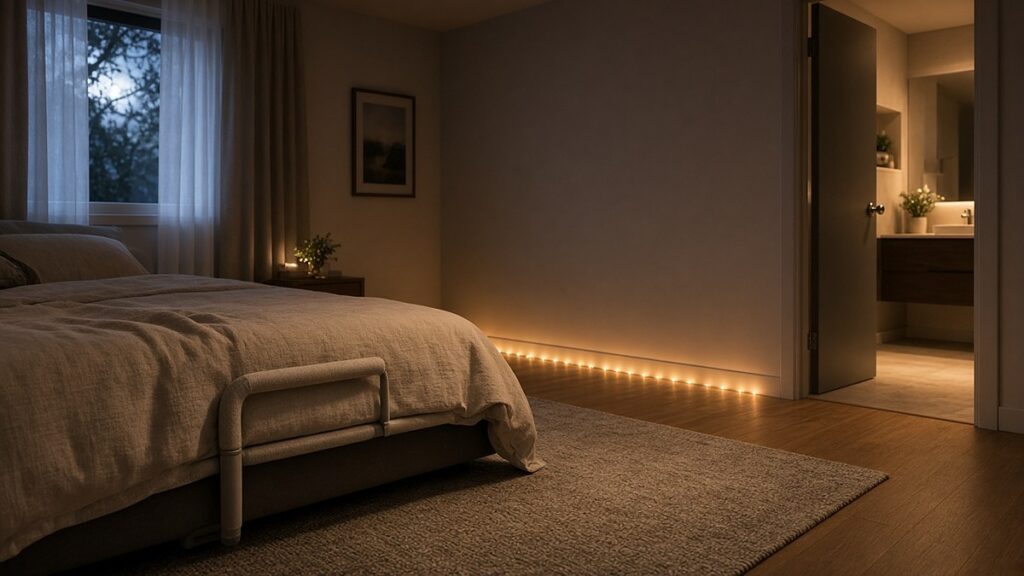
Where to put them: one near the bed at floor level, one along the hallway, and one inside the bathroom. Walk the route at night to find dark spots.
Step Two: A Steady Hand at the Bedside
Getting from lying down to standing is a real transition, especially for anyone whose blood pressure drops on standing. The NIA advises standing up slowly. Something solid to hold while you sit at the edge of the bed for a moment, then rise, can help.
Stander EZ Adjust Bed Rail
The Stander EZ Adjust Bed Rail works as a handle for sitting, standing, and repositioning, and it extends from 20 to 30 inches. Stander says it passed the ASTM F3186-17 safety standard for adult portable bed rails, which addresses falls and entrapment. It straps to traditional beds (platform, box spring, or slats), fits mattresses 10 to 14 inches thick, supports up to 300 pounds, and includes an organizer pouch for glasses and a phone. Check current price.
Important: Stander says this rail is not intended for adjustable beds or hospital beds. Follow the installation instructions closely and keep the strap snug. Gaps between a rail and mattress can create an entrapment risk.
Stander Security Pole and Curve Grab Bar
For more support, the Stander Security Pole is held between floor and ceiling by tension, with no drilling. Its curved grab bar rotates 360 degrees and locks every 45 degrees, and Stander rates it for 300 pounds. It can stand beside the bed, a favorite chair, or the toilet. Stander says it needs a flat ceiling (not vaulted) and cannot be used inside a tub or shower. Check the height range for your ceiling on the product page before ordering. Have a capable helper install it and recheck the tension from time to time. Check current price.
Step Three: The Right Walking Support
If balance is shaky, a walking aid can help, but fit matters. The NIA says canes and walkers should be the right size, walker wheels should roll smoothly, and borrowed equipment should be checked by a health care provider. A physical or occupational therapist can help choose and adjust one.
Vive Lightweight Rollator
The Vive Lightweight Rollator weighs 14 pounds and supports up to 300 pounds. Its 24-by-23-inch frame is designed to fit through doorways and tight spaces, handles adjust from 31 to 36 inches, and dual brakes both slow the rollator and lock it in place. A lighter frame is easier to lift into a car or over a threshold. Check current price.
Alternative: Drive Medical Rollator Walker with Seat
The Drive Medical Rollator Walker with Seat on Amazon has a steel frame, 7.5-inch wheels, a padded seat with a fold-down backrest, locking hand brakes, and a 350-pound weight capacity. At about 20 pounds, it is heavier than the Vive. Check current price.
A note on rollators at night: always lock the brakes before sitting on the seat or using the rollator to stand. In a small bedroom or bathroom, make sure there is room to turn it.
Step Four: Finish at the Bathroom
The trip ends at the toilet, often the hardest place to sit and stand. The Vive Toilet Safety Rail attaches with the existing seat bolts, adjusts in width and height, and supports up to 300 pounds. Check current price. Our companion guide to bathroom safety covers grab bars, shower chairs, and raised toilet seats in more detail.
What to Look For
- Lights: motion sensing, a dusk-to-dawn sensor, soft warm light rather than glare, and an automatic shut-off.
- Bed rails: certification to the ASTM F3186 adult bed rail standard, a secure strap, and a match to your bed type and mattress thickness.
- Support poles: a flat ceiling within the stated height range and a grab bar that locks in position.
- Rollators: handle height that fits the user, reliable locking brakes, a weight you can lift, and a frame narrow enough for your doorways.
- Weight capacity with a comfortable margin.
Simple Nighttime Habits
- Keep a phone or landline near the bed, as the NIA recommends.
- Sit at the edge of the bed for a moment before standing.
- Clear the path of shoes, cords, and throw rugs.
- Wear non-slip footwear or slippers with backs rather than walking in socks.
- Ask a doctor or pharmacist about medicines that cause dizziness or sleepiness, which the NIA lists as a fall risk.
Frequently Asked Questions
Are bed rails safe for older adults?
A bed rail can help with sitting up and standing, but it must fit the bed correctly to avoid gaps that could trap a person. Look for rails tested to the ASTM F3186 adult bed rail standard, follow the instructions exactly, and do not use a rail on a bed type the maker excludes. If you have concerns, ask a health care provider.
How many night lights do I need?
Enough that every step from the bed to the toilet is lit. For most homes that means one near the bed, one or more in the hallway, and one in the bathroom.
Rollator or cane?
It depends on how much support is needed. A rollator offers more stability and a place to sit; a cane offers lighter support. A physical or occupational therapist can recommend the right aid and size it correctly.
Do I need to drill holes to install a security pole?
The Stander pole uses tension between floor and ceiling and does not require drilling, though Stander includes hardware for permanent mounting if you prefer.
Living Well Begins at Home. A lit path and a steady hand-hold can make nights calmer for everyone in the house. Questions? Reach us at smartliving@gentreeliving.com.